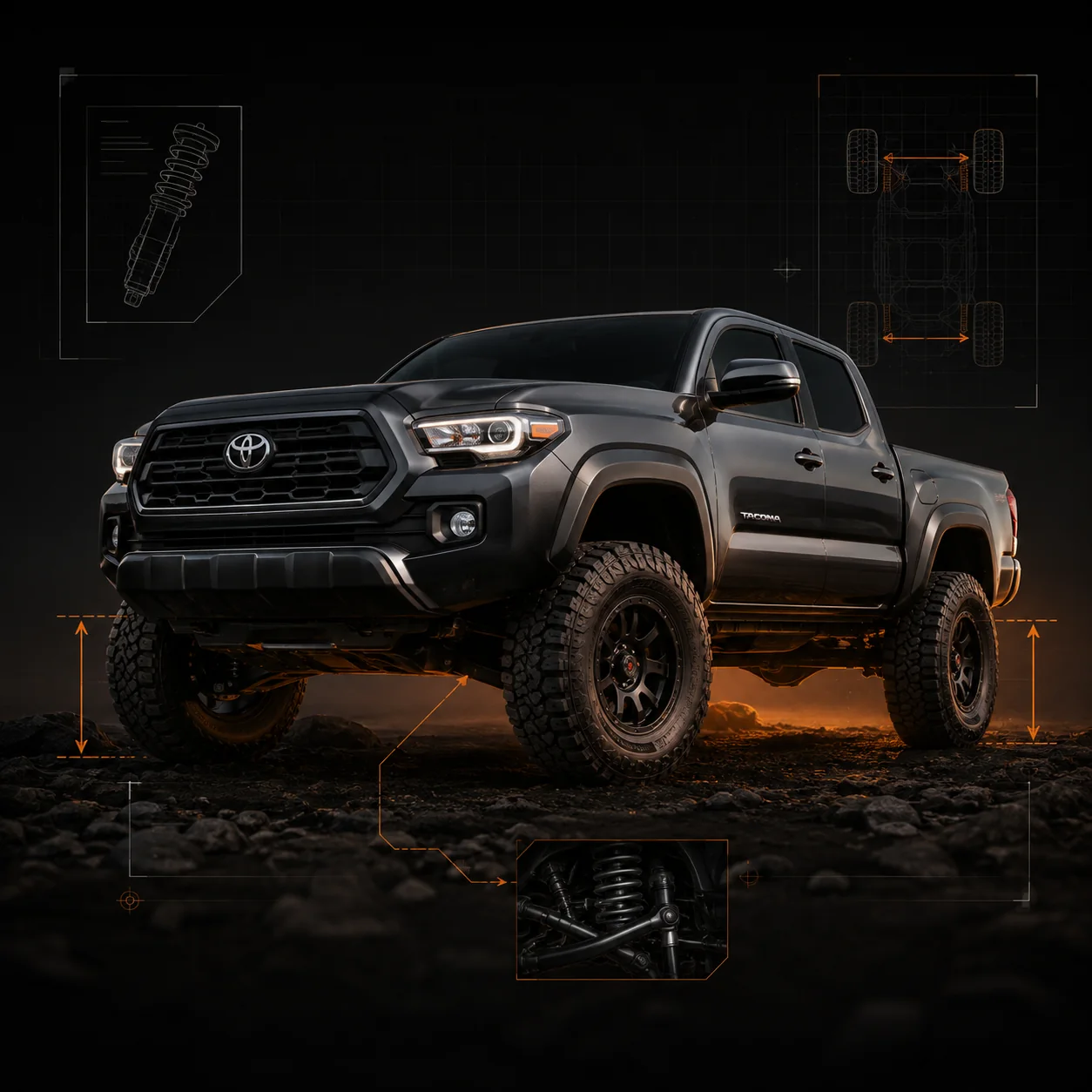
Begin with purpose, measurements, and the exact Tacoma
Record model year, trim, cab, bed length, drivetrain, factory suspension, current ride height, tires, wheels, alignment, front accessories, permanent bed load, passengers, towing use, and prior modifications. Measure the truck on level ground in its normal operating condition.
A mild daily-driver level, a tire-clearance plan, a trail-focused suspension change, and a constant-load travel setup solve different problems. Choose the smallest complete change that serves the defined use without hiding load or fitment problems.
undefinedundefinedundefined
Compare common Tacoma lift approaches
| Approach | What it changes | Key checks |
|---|---|---|
| Top spacer or leveling approach | Front static height and stance without automatically changing spring rate or damper quality | Exact assembly, droop, compression, top-out, CV and ball-joint angles, alignment, bump stops, and loaded rake |
| Preload adjustment where supported | Spring preload and installed ride height, with possible ride and travel trade-offs | Manufacturer adjustment range, spring and damper pairing, droop, damping, alignment, and normal load |
| Replacement front coilover | Spring, damping, height, and travel as an application-specific assembly | Model and trim fitment, control arms, CV joints, tie rods, sway bar, bump stops, lines, tires, and alignment |
| Rear add-a-leaf or leaf pack | Rear spring support, progression, height, and empty or loaded behavior | Measured constant load, empty-bed comfort, bushings, U-bolts, axle wrap, bump timing, shocks, and brake lines |
| Rear block where applicable | Rear static height without automatically improving spring control | Axle location, U-bolts, wrap, shock length, bump stops, load, towing, and manufacturer instructions |
| Complete suspension system | Height, spring support, damping, geometry, bump control, and travel as a package | Exact truck configuration, tires, permanent load, alignment, motion limits, road behavior, and maintenance |
Choose lift strategy by real use
Daily driving with a mild level
- Prioritize
- Predictable ride, adequate droop and compression, useful alignment, and normal loaded stance.
- Can wait
- Extra height that reduces ride quality or creates avoidable geometry demands.
- Confirm
- Current rake, passengers, front accessories, bed load, tire goal, and commute.
Weekend trails
- Prioritize
- Controlled travel, protection, recovery, modest clearance, steering reliability, and road behavior.
- Can wait
- Maximum height before the actual obstacles and tire plan are known.
- Confirm
- Terrain, tire dimensions, wheel position, normal load, recovery plan, and starting suspension.
Larger tire objective
- Prioritize
- Dynamic tire clearance, wheel geometry, steering sweep, compression, braking, gearing, and spare storage.
- Can wait
- Assuming a lift alone resolves body-mount, liner, bumper, or suspension contact.
- Confirm
- Measured tire dimensions, offset, backspacing, caster, steering lock, load, and prior changes.
Loaded travel truck
- Prioritize
- Measured permanent weight, rear spring support, damping, axle load, braking, and stable handling.
- Can wait
- Spring selection before the rack, cap, tent, storage, water, power, spare, and tools are planned.
- Confirm
- Front and rear scale weights, trip inventory, daily unloaded use, passengers, and trailer tongue load.
Height changes a connected motion system
Supporting systems to inspect and verify
Upper control arms
Alignment range, ball-joint angle, droop, compression, tire clearance, strength, and exact application; replacement is not automatically required.
CV joints and axles
Operating angle, boot clearance, binding, plunge, steering, droop, compression, and service condition.
Tie rods and steering
Joint range, wheel offset, tire mass, steering lock, trail impacts, alignment, and clearance.
Bump stops
Tire and body clearance, shock protection, retained uptravel, mount compatibility, and load.
Sway bars and links
Link angle, joint range, interference, retained road behavior, and manufacturer instructions.
Rear leaves, U-bolts, and shocks
Spring support, axle location, wrap, bushings, shock length, damping, bump timing, brake lines, and empty-bed ride.
Alignment
Caster, camber, toe, steering-wheel position, adjustment range, return-to-center, braking, and tire wear.
Lift installation and verification checklist
- Exact model year, trim, cab, bed, drivetrain, factory suspension, wheels, tires, towing equipment, and prior modifications
- Measured front and rear ride height empty and at representative load
- Control arms, ball joints, CV joints and boots, tie rods, sway bars, brake hoses, ABS wires, driveshafts, and bump stops through motion
- Shock compression and droop limits, spring retention, rear U-bolts, leaf behavior, axle wrap, and mount clearance
- Full-steering and controlled-compression tire clearance at suspension, body mount, liner, fender, bumper, mud flap, hoses, and wiring
- Caster, camber, toe, steering-wheel position, adjustment range, and printed alignment results
- Braking, return-to-center, lane changes, loaded stance, towing response, noises, and stability
- Fastener torque, line routing, leaks, settling, tire wear, alignment, and post-installation reinspection
Common Tacoma lift mistakes
Buying only by advertised height
Spring rate, damper travel, damping, geometry, load, bump control, steering, and installation define the complete system.
Assuming a spacer adds travel
Changing static position does not automatically increase damper stroke, droop, compression, or useful wheel travel.
Treating tire fitment as solved
Wheel position, caster, steering, compression, the body mount, liners, bumper, load, and actual tire dimensions still matter.
Selecting rear springs from a future wish list
Choose rear support from measured permanent and representative trip load while considering empty-bed use.
Using height to hide overload
A level stance does not increase manufacturer payload, axle, tire, hitch, or towing ratings.
Skipping alignment and reinspection
Verify alignment, torque, line routing, contact marks, settling, and tire wear after installation and initial use.
Confirm tire and wheel constraints in the Tacoma tire size and fitment guide.
Tacoma lift-kit questions
Does every lifted Tacoma need upper control arms?
No universal rule applies. The need depends on the actual height change, alignment range, ball-joint angle, droop, tire clearance, component design, and manufacturer application.
Does a lift guarantee larger tires will clear?
No. Dynamic tire fitment still depends on wheel geometry, caster, steering sweep, suspension travel, body mount, liners, bumper, load, and the tire's measured dimensions.
Can rear lift parts increase payload?
No. Springs, leaves, blocks, or load-assist parts can change stance or control but do not raise the manufacturer's certified vehicle, axle, tire, hitch, or towing ratings.
Personalized planning
Build Your Tacoma Plan
RigAI uses your model year, trim, cab, bed length, drivetrain, driving profile, budget, installed equipment, payload, and planned load to organize what to consider first and what can wait.
Editorial transparency
Editorial and fitment notes
This guide is informational. Vehicle configurations vary, and manufacturer fitment data is the final source for a specific part. RigAI reviewed this page against the technical sources listed below.
Editorial responsibility: RigAI Editorial Team
Last reviewed: August 31, 2026
Core sources
- 2023 Toyota Tacoma eBrochureToyota official brochure
- 2023 Toyota Tacoma model overviewToyota USA Newsroom
- 2022 Toyota Tacoma manuals and warrantiesToyota Owners
- 2017 Toyota Tacoma TRD Pro technical overviewToyota USA Newsroom