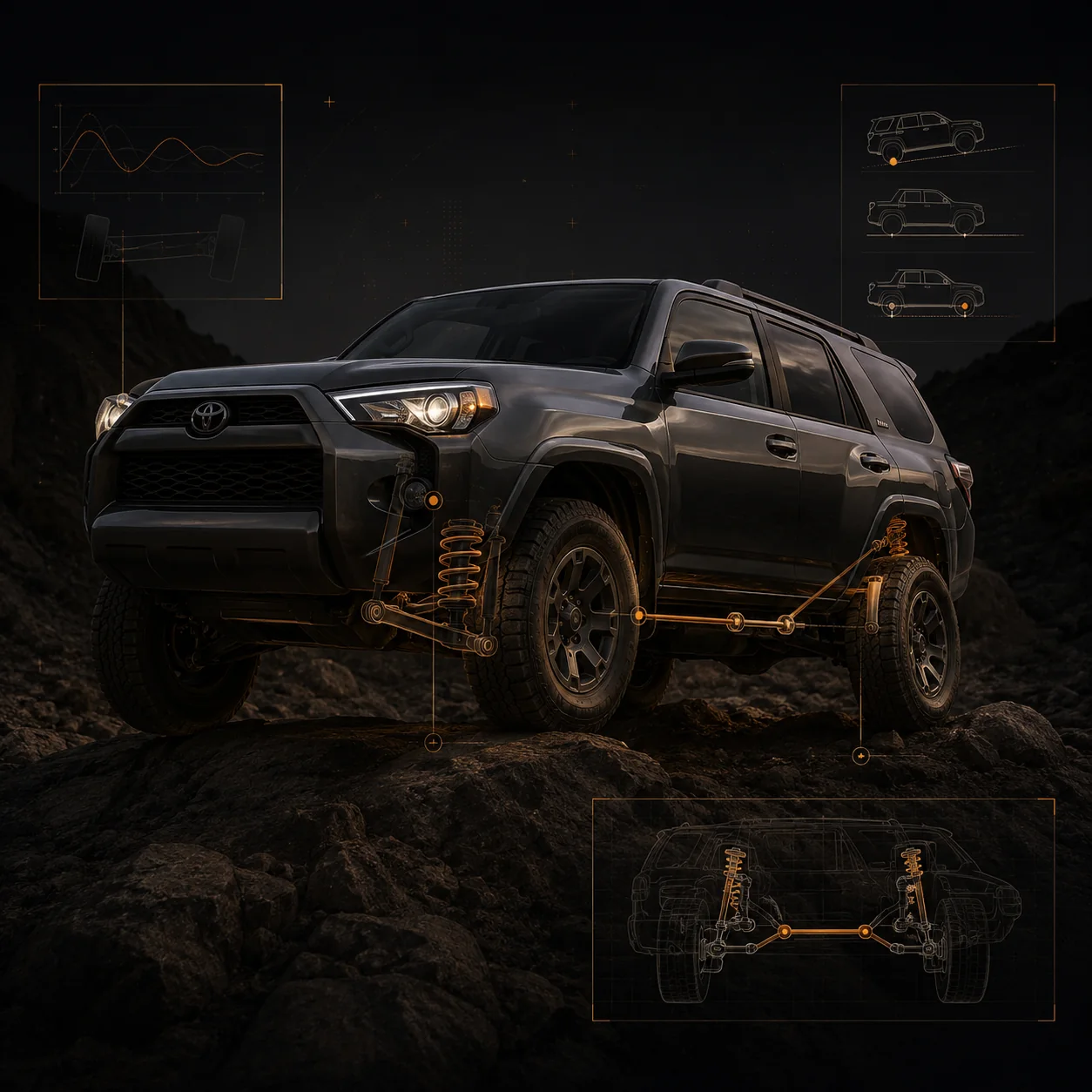
Why KDSS matters before you buy suspension parts
Toyota describes the Kinetic Dynamic Suspension System as a system that adjusts stabilizer-bar resistance. It can allow the bars to behave differently when the vehicle is on a road and when wheel movement is needed off road.
That makes KDSS a configuration input for a lift or suspension plan. A part listed for a conventional 5th Gen 4Runner should not be assumed to cover a KDSS-equipped vehicle unless the manufacturer application and instructions say so.
See the wider system decision in the Toyota 4Runner suspension guide.
What KDSS does in plain language
Stabilizer bars help resist body roll. Toyota's description of KDSS says the hydraulic system can reduce stabilizer-bar resistance off road while retaining conventional stabilizer-bar behavior on road. The practical point is that the system participates in how the vehicle controls body movement.
KDSS does not make modification automatically impossible. It means the part application, installation process, final ride height, and post-install checks need to account for the system that is actually on the vehicle.
How to identify whether a 4Runner has KDSS
Use more than a trim badge or an online comment. Availability can vary by year, market, and specification.
- Check the original build sheet or option list for the exact vehicle
- Use a VIN-based specification source from Toyota or an authorized dealer
- Review owner documentation for the exact model year and market
- Ask a qualified technician to identify the KDSS hydraulic components and stabilizer-bar hardware
- Record the result in the vehicle plan before comparing parts
KDSS and lift-kit planning
The kit manufacturer should explicitly list the compatible generation, model year range, drivetrain, and KDSS status. Follow the manufacturer procedure because installation and settling checks may differ from a non-KDSS vehicle.
A side-to-side ride-height difference can have several inputs: surface level, fuel and cargo distribution, spring seating, prior spacers, component condition, or system state. Measure on a level surface and have the complete installation inspected before choosing a correction.
Use the 4Runner lift-kit decision guide to define the height, load, and geometry goal before comparing kits.
KDSS suspension selection factors
A KDSS label is not the whole specification. These inputs still determine whether a setup suits the vehicle.
Shocks and springs
Confirm the exact application and select springs around real front and rear constant load.
Stabilizer-bar behavior
Use a kit and installer familiar with the KDSS-equipped configuration.
Alignment
Measure alignment after installation and confirm adjustment remains suitable.
Terrain
Match control and travel goals to actual roads, trails, speed, and frequency.
Daily comfort
Account for normal passenger load, commute quality, noise, and access height.
Installation experience
Choose instructions and an installer that cover the complete KDSS system, not only the damper.
KDSS decision framework
| Question | Why it matters | How to verify | Decision affected |
|---|---|---|---|
| Does this vehicle have KDSS? | The system changes the relevant fitment and procedure | Build sheet, VIN specification, or qualified inspection | Eligible parts and installer |
| What constant weight is installed? | Load changes spring compression and final ride height | Inventory front and rear accessories and cargo | Spring range and damping |
| What is the measured baseline? | Existing lean or wear can distort the result | Level-ground measurements and inspection | Repair, diagnosis, or modification |
| What does the manufacturer approve? | Applications and procedures are product-specific | Current fitment guide and installation manual | Kit choice and installation |
| How is the vehicle used? | Road comfort and off-road control require different compromises | Driving profile and terrain record | Damping, height, and maintenance |
What to verify before purchase
- Model year, market, trim, and drivetrain
- Confirmed KDSS presence
- Current ride height measured on level ground
- Existing spacers or suspension changes
- Bumper, winch, armor, and front constant weight
- Rear constant load and occasional cargo
- Manufacturer statement for KDSS compatibility
- Installer experience with the specified system
- Alignment and post-install inspection requirements
Common KDSS planning mistakes
Assuming from the trim
Confirm the exact vehicle because year, market, options, and prior changes matter.
Buying before checking the application
Use current manufacturer fitment data that names the KDSS configuration.
Correcting lean with a random spacer
Measure, inspect, and diagnose the system and load distribution first.
Copying a non-KDSS setup
The same advertised height does not make two configurations equivalent.
Ignoring added weight
Bumpers, winches, armor, cargo, and roof equipment change the spring requirement.
Skipping final measurements
Record ride height and alignment after installation and settling.
If this is an early-stage vehicle, check what to upgrade first on a 4Runner before making suspension the first purchase.
Personalized planning
Build Your 4Runner Plan
RigAI uses your generation, trim, drivetrain, KDSS status, driving profile, budget, installed equipment, and planned load to organize what to consider first and what can wait.
Editorial transparency
Editorial and fitment notes
This guide is informational. Vehicle configurations vary, and manufacturer fitment data is the final source for a specific part. RigAI reviewed this page against the technical sources listed below.
Editorial responsibility: RigAI Editorial Team
Last reviewed: August 31, 2026
Core sources
- Toyota 4Runner Icons: Fifth and Sixth GenerationsToyota USA Newsroom
- 2024 Toyota 4Runner: Rugged CapabilityToyota USA Newsroom
- Toyota 4Runner Owner's ManualToyota official manual