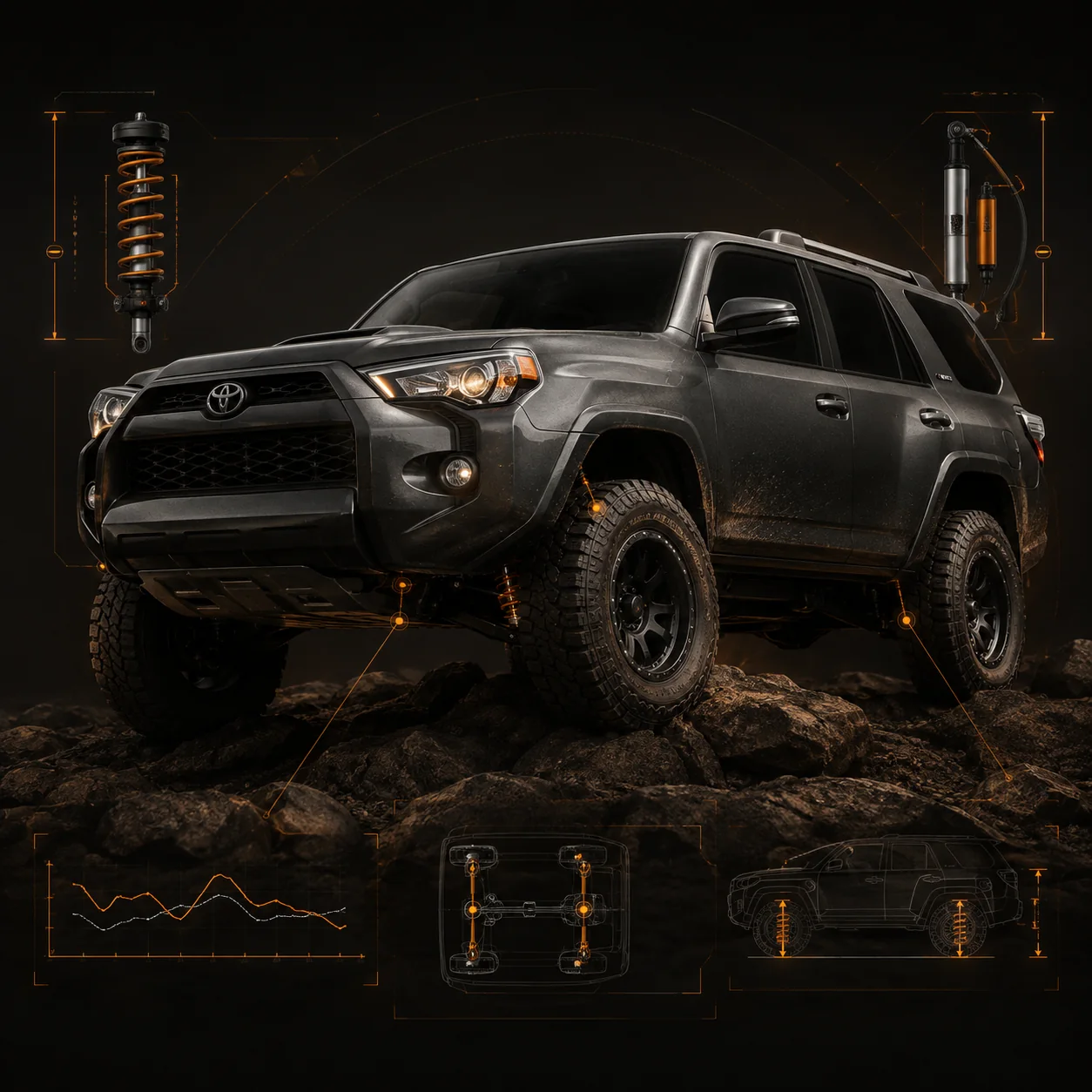
When does a suspension upgrade make sense?
A 4Runner suspension upgrade makes sense when the existing system is worn, the real load has changed, the vehicle needs more controlled damping for its terrain, or a carefully defined clearance and travel goal cannot be met by the current setup.
Stock suspension can remain the better choice for a lightly loaded daily driver that is in good condition and already works for its roads and trails. A lift by itself does not prove that the suspension performs better or that a planned tire will clear.
For the broader dependency map, start with the complete Toyota 4Runner upgrade guide.
Start with the use case
Daily driver
- Prioritize
- Comfort, predictable control, noise, and maintaining useful road behavior.
- Can wait
- High-load springs or heat-management hardware without a matching need.
- Confirm
- Normal passenger/cargo load, road quality, current wear, and tire plans.
Daily + weekend trails
- Prioritize
- Balanced road comfort, controlled repeated movement, and appropriate clearance.
- Can wait
- Selecting by advertised height before checking load and geometry.
- Confirm
- Trail surface, frequency, speed, obstacles, tire size, and current alignment.
Overland load
- Prioritize
- Constant-load support, damping control, reliability, and loaded handling.
- Can wait
- Spring selection before the front and rear weight inventory is stable.
- Confirm
- Bumper, winch, armor, drawers, water, fuel, roof load, passengers, and trip cargo.
More demanding off-road use
- Prioritize
- Control, heat management, usable travel, protection, and serviceability.
- Can wait
- Copying a competition-style setup onto a mixed-use vehicle.
- Confirm
- Terrain, speed, articulation needs, expected impacts, maintenance, and supporting parts.
Stock vs upgraded suspension
| Decision | When it may fit | What to inspect | Main caution |
|---|---|---|---|
| Keep stock | Healthy system, modest load, mostly road use, and suitable trail behavior | Leaks, bushings, ride height, tire wear, alignment, and control | Age or wear can make a stock-vs-aftermarket comparison misleading |
| Refresh near stock | Worn components but no major load or clearance change | Complete component condition and matched replacement parts | Replacing only one weak component may leave another problem |
| Upgrade for load | Constant bumper, winch, armor, cargo, or travel load | Measured front/rear load and how often it is carried | Heavy-load springs can be uncomfortable when the vehicle is usually empty |
| Upgrade for terrain/control | Repeated rough-road use exposes a control or heat-management need | Driving speed, surface, travel, damping, and service requirements | More aggressive hardware can add cost and maintenance without helping daily use |
Lift height is not suspension quality
Ride height describes where the vehicle sits; suspension performance describes how springs, dampers, geometry, tires, and supporting components manage movement and load. Two setups at a similar height can behave very differently.
More height can introduce compromises in alignment, component angles, usable travel, steering feel, and access to factory adjustment. Evaluate the complete operating range instead of treating height as the result.
High-level suspension types
Architecture alone does not make one damper universally better. Vehicle tuning, heat, load, travel, serviceability, and price all matter.
Twin-tube
Uses an inner working tube and an outer compensation chamber. Often appropriate for conventional road-focused use.
Monotube
Separates the gas and oil with a floating piston and can support consistent damping under demanding use.
Remote reservoir
Adds fluid and gas capacity outside the main body; useful only when the use case benefits from the added heat capacity and complexity.
Adjustable systems
Allow some tuning inputs, but adjustments still need a sound baseline and documented procedure.
Load-matched springs
Should be selected around real front and rear constant load, ride goals, and the matching damper.
Complete matched systems
Can reduce guesswork when springs, dampers, travel, and fitment are engineered for the same configuration.
Added weight changes the suspension requirement
Treat KDSS as a separate fitment input
Toyota describes KDSS as a hydraulic system that changes stabilizer-bar behavior between road and off-road conditions. It was not installed on every 5th Gen configuration.
Confirm whether the exact vehicle has KDSS before selecting a kit. Use the suspension manufacturer's application notes and installation instructions; do not assume a non-KDSS and KDSS-equipped vehicle accept the same parts or procedure.
Geometry and supporting components
A suspension plan should review these systems through the full steering and suspension range. The required solution depends on the actual height, parts, alignment result, and vehicle.
- Alignment range and final measured alignment
- Upper and lower control-arm clearance and joint angles
- Front CV angles and boot condition
- Rear axle and panhard-bar relationship
- Bump-stop engagement and usable travel
- Brake-line and ABS-wire routing
- Sway-bar behavior and KDSS-specific instructions
- Tire clearance at steering lock and suspension compression
Suspension decision framework
| Use case | Primary goal | Spring/load | Damping priority | Main compromise | Verify |
|---|---|---|---|---|---|
| Mostly daily driving | Restore control and comfort | Near-normal constant load | Predictable road response | Aggressive tuning may reduce comfort | Condition, trim, KDSS, tires, alignment |
| Daily + weekend trails | Balanced road and trail control | Light or moderate confirmed load | Repeated rough-road control | Cost and firmness can rise | Terrain, travel, clearances, loaded use |
| Overland travel | Support a stable constant load | Front and rear load inventory | Loaded control and heat management | Unloaded ride may change | Payload, roof load, spring range, service |
| Demanding off-road use | Control and usable travel | Exact operating load | Terrain- and speed-specific | Maintenance, cost, road compromise | Component limits, geometry, installation |
What to verify before purchase
- Model year and 5th Gen confirmation
- Trim and drivetrain
- KDSS status
- Current lift and suspension parts
- Existing front and rear accessories
- Front constant weight
- Rear constant load and occasional cargo
- Current and planned tires and wheels
- Installer requirements and alignment capability
- Manufacturer application, exclusions, and instructions
Common suspension-planning mistakes
Buying for height alone
Define control, load, travel, and terrain goals before comparing height.
Choosing springs too early
Finalize constant weight before selecting a spring range.
Ignoring alignment
Plan for a measured post-install alignment and inspect the available adjustment.
Assuming tire clearance
A lift does not replace full steering and compression clearance checks.
Using heavy-duty springs unloaded
Match spring load range to how the vehicle is normally driven.
Copying another 4Runner
Match generation, trim, KDSS, load, tires, terrain, and compromises instead.
See how suspension fits into the first upgrades for a 4Runner instead of treating it as an isolated purchase.
Personalized planning
Build Your 4Runner Plan
RigAI uses your generation, trim, drivetrain, KDSS status, driving profile, budget, installed equipment, and planned load to organize what to consider first and what can wait.
Editorial transparency
Editorial and fitment notes
This guide is informational. Vehicle configurations vary, and manufacturer fitment data is the final source for a specific part. RigAI reviewed this page against the technical sources listed below.
Editorial responsibility: RigAI Editorial Team
Last reviewed: August 31, 2026
Core sources
- Toyota 4Runner Icons: Fifth and Sixth GenerationsToyota USA Newsroom
- 2024 Toyota 4Runner: Rugged CapabilityToyota USA Newsroom
- Toyota 4Runner Owner's ManualToyota official manual
- Monotube and twin-tube shock absorber principlesBILSTEIN technical resource
- Choosing suspension for vehicle loadARB technical resource